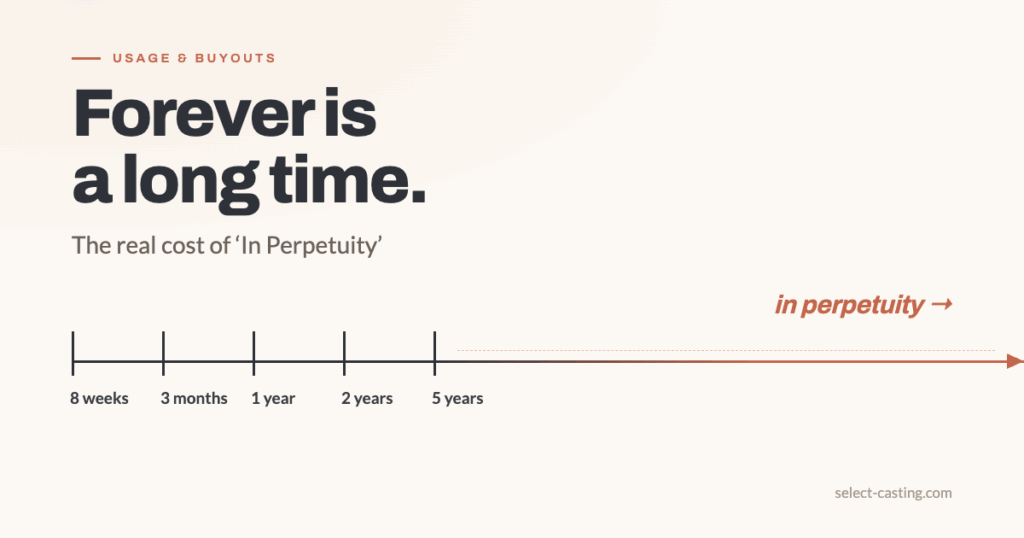
Whenever I see “in perpetuity” on a casting sheet — or get asked to pull rates for a project that wants it — I flinch. It’s a no-fly zone in this industry, and it causes a lot of agitation for talent agents and actors.
My take is simple: a client can always ask for in perpetuity, but I don’t think I’ve ever seen a project that needed it. I racked my brain, and the only ad I could come up with that’s been running forever is the Corona Christmas commercial — the one where a guy whistles and the palm trees light up.
Ads are temporary by nature. A new product release. A sale going on right now. The work is built around a moment, and that moment passes — maybe in a month, maybe in two years. The 2025 car is replaced with the 2026. A new actor becomes the voice of the brand. New leadership pushes the creative in a different direction. So why do clients ask for in perpetuity?
Most of the time, I think it’s because it’s easier to ask for than to work out a term that actually fits the campaign. One line on a spec sheet instead of a conversation about how long this thing will really run. But it’s a shortcut with consequences: it hurts participation, and it hurts the creative you get back — unless the client is willing to pay a massive talent fee.
So rather than keep making that case myself, I asked a group of talent agents to explain why perpetuity causes so many problems. Their answers are below, names removed.
The short version
- Usage fees are ongoing compensation. Perpetuity ends the talent’s pay after one check while the client’s use continues forever.
- The conflict never expires. One spot for one brand can lock a performer out of that entire category permanently — and that holds even if you don’t ask for exclusivity.
- The rate multiplies. With no renewals coming, everything the talent will ever earn has to be collected up front. Expect several times a normal term buyout.
- You lose the good talent. Most established agents pass on perpetuity without telling you they passed. You just get a thinner audition pool.
- The material won’t last that long anyway. Most campaigns are retired in two to three years.
What the agents said
On the basic problem:
“In perpetuity is always a big no-no for us. It basically takes advantage of the talent — the client keeps using their voice with no further remuneration.”
“We don’t ever accept in perpetuity jobs. First and foremost, the rate is never high enough.”
On conflict:
“If Joe’s Burgers is using someone’s voice, that gives them a QSR conflict FOREVER, excluding them from being on spots for McDonald’s, BK, Wendy’s, etc.”
“A talent can pick up really big accounts throughout their career — and to know that something is potentially running forever, and that it can hinder their ability to sign on to a completely conflict-free scenario for a large brand, is problematic.”
“It doesn’t matter to our actor if the ad agency for the non-union spot doesn’t hold a conflict. The performer has a conflict as far as everyone else is concerned, especially any future ad agency interested in hiring the performer for a commercial holding the same conflict.”
“While a company may choose to hold a performer in perpetuity without conflict, others may still see their past work as a conflict, meaning the performer won’t be hired or considered, even though they technically have ‘no conflict.’ It’s a nice way of trying to circumvent the problem that they’re creating for performers.”
“Size of the conflict area is almost the most important factor. The larger the conflict area the more expensive.”
Worth understanding what that last one means for budgeting: the conflict area isn’t something anyone negotiates. An energy drink ad conflicts with energy drinks. An auto spot conflicts with auto. The ad is what the ad is. So if your category is a broad one, that cost is baked in before you ever go out — and the only variable left to control is how long you hold it.
On whether it’s even necessary:
“Forever is a long time and unless it’s for a good cause — a la PSA — 9 times out of 10 the content is irrelevant in 2-3 years.”
“Given how advertising and the turnover of ads and buys function today, there isn’t really any good reason to hold someone in perpetuity.”
On what many agents will agree to:
“When asked for in perp, we default to a 5 year term and that usually will suffice. And of course only in the digital space. NEVER for streaming + linear space do we offer that scenario.”
“We almost always allow ‘in perpetuity’ for agency and client’s website and non-paid socials. (No paid advertising, digital, cable, broadcast, or other.)”
“A commercial in perpetuity? Big no-no, absolutely not… But an industrial, a learning video, a tutorial — something that doesn’t obviously generate money for the client. We still don’t like the term, but we can live with it on certain types of assets.”
What to do instead
Start with an honest question: how long do you actually expect to run this? Then build the rate around that term. You’ll spend less, and you’ll get more participation from top talent.
And if your client insists on in perpetuity, don’t fret. We’re always happy to help you land on a fair rate. It’s just good to know the pitfalls that come with that request, and to avoid the term unless it’s absolutely necessary.